
Written by Amy Hufnagel and Giovanna Phipps
Amy is the Associate Director of the Sing Sing Prison Museum and Giovanna Phipps is the Social Media Manager of the Sing Sing Prison Museum.
 | The Sing Sing Prison Museum (SSPM) has a revised mission statement. Sing Sing Prison Museum shares stories of incarceration and reform, past and present, and brings people together to imagine and create a more just society. This mission helps us focus our work yet is broad enough to allow for lots of invention and creativity. As we begin to put this new mission into practice, we start by reactivating “What we are reading” by sharing a book and podcast. Our June 2023 recommendations link both to our mission and to celebrating Pride Month. We want to encourage our audiences to consider and learn from all who identify as LGBTQIA+ and their allies. |
| Reading and listening is a means to share important stories. Literacy, and access to digital resources, is a social justice issue. Reading and listening to be more informed about the nuances of people’s lives and experience, to truly understand their life stories, builds empathy and can lead to more social justice engagement. To that end, The Sing Sing Prison Museum continues its “What we are Reading” series and adds a “listening” component. Further, starting this fall, we will also add a community engagement component to these books and podcast episodes for those who live in the Ossining, NY region. The in-person component, an evening discussion, will be co-hosted by our amazing local independent Hudson Valley Books for Humanity. We are also working with our local library to make sure the books we profile are available for free to our community as well. Be sure to join our newsletter to receive news of this and other events |  |
First, what we are listening to: “Do You Know Who I Am” from Ear Hustle explores the effect of a 2021 California State law allowing transgender, intergender, and nonbinary people to transfer to a prison that aligns with their gender identity. As a result of this law, individuals have experienced prisons both as women and as men, and universally express that male incarceration facilities are vastly different than female institutions. In an interview, one transgender individual, Kier, states, “I did not want to come out as trans because I feared that I would be raped or otherwise mistreated. I did not want to be exploited or used or abused or killed by the other inmates. And I didn't want to be perceived as weak for being trans either. I didn’t want that attention, and so I let my hair grow and I let my beard grow. And that went on for years. I had a gigantic Jeremiah Johnson mountain man beard, and nobody wants that guy. So, it was pretty effective at keeping the hound dogs at bay. But I was also pretty miserable because I wasn't myself.”
On the other hand, some individuals did not feel safe going into a men’s prison as a transgender male. The rates of transgender females transferring to female prisons are substantially higher than transgender males transferring to male prisons – as referenced in the episode, no transgender males have transferred. The requirement to be transferred is to identify as trans female or male, but the vetting process can take years to be approved. Some believe that cisgender males will use this legislation to have access to better prison conditions or to both cisgender and transgender females. For more, listen here:
On the other hand, some individuals did not feel safe going into a men’s prison as a transgender male. The rates of transgender females transferring to female prisons are substantially higher than transgender males transferring to male prisons – as referenced in the episode, no transgender males have transferred. The requirement to be transferred is to identify as trans female or male, but the vetting process can take years to be approved. Some believe that cisgender males will use this legislation to have access to better prison conditions or to both cisgender and transgender females. For more, listen here:

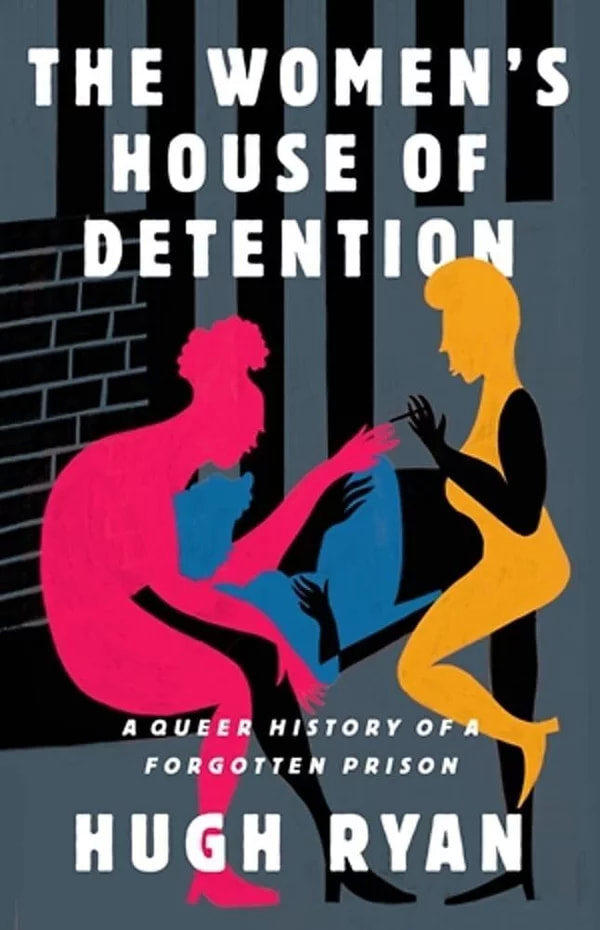
Second, what we are reading: In Greenwich village during the late sixties and seventies, The Women’s House of Detention was a nexus for high numbers of women, transgender men, and gender non-conforming individuals. Today, one third of individuals in women’s prisons identify as queer. The Women’s House of Detention: A Queer History of a Forgotten Prison, written by Hugh Ryan (Bold Type Books [2022]),explores the history of queerness in prison as well as how queer incarcerated individuals present a unique case for rethinking prison. Legislation dating back to the mid-1800s, called the anti-masquerade law, criminalized alternative female behaviors, and was not applied to men and boys until the 1920s. Ryan notes in his interview with Terry Gross on NPR’s Fresh Air that for incarcerated men, the intention is to return them as good citizens whereas incarcerated women are expected to return as good women.
Ryan states, “And that is the reason why so many gender-nonconforming people, why so many queer women, lesbian women, butches, studs, trans men get caught up in the prison system, because for those people who are concerned about the lives of incarcerated and formerly incarcerated people, queerness was seen as a threat to ever being a normal, healthy, happy, productive member of society.” As we expand our definitions of gender expression and identity, the rigidity of gender in the United States Incarceration system comes under scrutiny.
Ask your local bookstore to find you the book! This book is also available at the Chappaqua Library, Irvington Public Library, Ossining Public Library, Rye Free Reading Room, Scarsdale Public Library, Scarsdale Public Library, White Plains Public Library, and Yonkers Grinton I. Will Library, and Yonkers Riverfront Library.
Ryan states, “And that is the reason why so many gender-nonconforming people, why so many queer women, lesbian women, butches, studs, trans men get caught up in the prison system, because for those people who are concerned about the lives of incarcerated and formerly incarcerated people, queerness was seen as a threat to ever being a normal, healthy, happy, productive member of society.” As we expand our definitions of gender expression and identity, the rigidity of gender in the United States Incarceration system comes under scrutiny.
Ask your local bookstore to find you the book! This book is also available at the Chappaqua Library, Irvington Public Library, Ossining Public Library, Rye Free Reading Room, Scarsdale Public Library, Scarsdale Public Library, White Plains Public Library, and Yonkers Grinton I. Will Library, and Yonkers Riverfront Library.
 RSS Feed